The information on this website is general in nature and does not take into account your objectives, financial situation, or needs. Consider seeking personal advice from a licensed adviser before acting on any information.
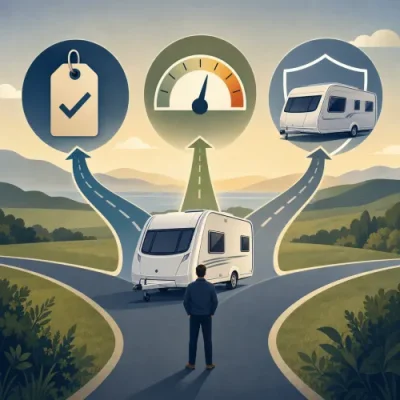
Agreed value, market value and new-for-old replacement can affect your caravan insurance premium and what may happen after a major claim. This guide explains how each settlement basis works, what to check in the policy wording and how to compare options more confidently.
When comparing caravan insurance, it is easy to focus on the premium and excess. But one of the most important policy features is how your insurer may value your caravan if it is stolen, written off or damaged beyond economical repair.
Agreed value, market value and new-for-old caravan insurance are different settlement approaches. They can affect your premium, your expectations at claim time and whether the payout is enough to repair, replace or move on from your caravan. This article explains the general principles so you can read policy documents and compare options with greater confidence.
What does "settlement basis" mean in caravan insurance?
The settlement basis is the method an insurer uses to decide what it may pay or provide after an insured event. In caravan insurance, it commonly becomes most important after a total loss claim, such as theft where the caravan is not recovered, severe storm or hail damage, fire, or an accident where repairs are not economical.
For smaller claims, the insurer may arrange or pay for repairs, subject to the policy terms, excesses, limits and exclusions. For major claims, the insurer may settle by repairing, replacing, paying an amount, or using another method set out in the Product Disclosure Statement and policy schedule.
The exact outcome depends on your policy wording, the insured event, the condition and value of the caravan, any accessories or modifications, your disclosures, and the insurer's claims assessment.
Agreed value caravan insurance
Agreed value caravan insurance means the insurer and policyholder agree on an insured value for the caravan when the policy starts or renews. That value is usually shown on the policy schedule.
If the caravan is a total loss, the agreed value is generally the starting point for the caravan insurance settlement. However, it may still be subject to the policy terms, excesses, deductions, limits, finance interests and any specific conditions in the policy wording.
How agreed value may be set
Insurers may consider factors such as the make, model, age, purchase price, condition, features, accessories, modifications and current market evidence. Some insurers may set a minimum or maximum agreed value range, while others may require documents, photos, invoices or valuation information.
Agreed value does not necessarily mean you can choose any amount. The insurer must be willing to accept the value, and it may revise the agreed value at renewal.
Potential advantages of agreed value
- More certainty: You can see the nominated value on your schedule before a claim occurs.
- Useful for well-maintained or customised caravans: It may better reflect features that are not obvious in a generic market comparison, provided they are declared and accepted.
- Clearer renewal conversations: You can review whether the insured value still reflects the caravan, accessories and market conditions.
Potential limitations of agreed value
- It may cost more: A higher agreed value can increase the insurer's exposure and may affect premiums.
- It can still be reduced by policy terms: Excesses, unpaid premiums, salvage rights, limits or other deductions may apply depending on the wording.
- It may become outdated: If your caravan depreciates, improves, is modified or changes condition, the agreed value may need review.
Market value caravan insurance
Market value caravan insurance means the insurer assesses the caravan's value at the time of the loss. The policy may define market value as the reasonable cost to replace the caravan with one of a similar make, model, age, condition and specification immediately before the insured event.
This approach can be less predictable than agreed value because the final amount is assessed after the claim. The insurer may consider sale listings, valuation guides, the caravan's condition, kilometres or usage where relevant, service records, accessories, modifications and the broader used caravan market.
What can influence market value?
- The caravan's age, make, model, layout and construction type.
- Its pre-loss condition, including maintenance history and existing damage.
- Factory options, declared accessories and accepted modifications.
- Availability of comparable caravans in the Australian market.
- Depreciation, demand and seasonal or regional market conditions.
- Whether the policy caps or limits particular items separately.
Market value may suit some owners, particularly if they want a policy where the insured amount broadly follows the used market. However, it can create uncertainty if similar caravans are difficult to find or if you disagree with the assessed value.
New-for-old caravan insurance
New-for-old caravan insurance is a replacement benefit that may apply if your caravan is a total loss and the policy conditions are met. Instead of settling only by an agreed or market value amount, the insurer may replace the caravan with a new equivalent or comparable model.
This benefit is often subject to strict conditions. For example, policies may limit new-for-old replacement to caravans below a certain age, within a defined ownership period, or where a suitable replacement is available in Australia. Some policies may require you to be the original owner, while others may apply different rules. You should check the wording rather than assuming the benefit applies automatically.
When new-for-old may not work as expected
New-for-old cover can sound simple, but practical issues may affect the outcome. The same model may no longer be made, a comparable model may have different features, delivery timeframes may vary, and accessories or customisations may be treated separately. The insurer may also have the right to choose the supplier or method of settlement.
If a new-for-old replacement is not available or the policy conditions are not met, the insurer may settle another way, such as paying the applicable insured value or market value, depending on the policy.
Agreed value vs market value vs new-for-old: key differences
| Settlement option | How it generally works | What to watch |
|---|
| Agreed value | A value is agreed with the insurer and shown on the policy schedule. | Check whether the value is current, whether accessories are included, and what deductions or limits may apply. |
| Market value | The insurer assesses the caravan's value immediately before the loss. | The final payout may be uncertain until claim time and may depend on comparable market evidence. |
| New-for-old | The insurer may replace the caravan with a new equivalent or comparable model if conditions are met. | Age limits, ownership rules, availability, model changes and accessory treatment can affect the outcome. |
How accessories, annexes and modifications may be valued
Caravans often include more than the base van. Solar panels, awnings, annexes, air conditioning, upgraded suspension, bike racks, satellite equipment, batteries, water tanks and internal upgrades can all affect value. Whether these are covered, and how they are valued, depends on the policy.
Some policies include certain accessories automatically up to a limit. Others require you to list them separately. Some may treat permanent fixtures differently from removable contents. If you have upgraded your caravan, it is important to tell the insurer and keep evidence such as receipts, installation records and photos.
Do not assume that an agreed value automatically includes every accessory or modification. Check whether the policy schedule separates the caravan, contents, annexe, equipment and optional extras.
Contents are usually a separate issue
Your caravan's insured value may not include personal belongings inside the van. Contents cover may have separate limits, sub-limits and exclusions. Items such as electronics, tools, camping gear, jewellery, portable appliances and sporting equipment may be subject to different rules.
If you travel for long periods or keep valuable items in the caravan, review the contents section carefully. A total loss of the caravan does not necessarily mean every item inside is covered for replacement value.
Why the settlement basis can affect your premium
The settlement basis changes the insurer's potential claim cost. A higher agreed value, broader new-for-old benefit or increased accessory limits can affect the price of cover. Other factors can also influence premiums, including your caravan type, storage location, security, claims history, usage, excess and the insurer's underwriting criteria.
Cheaper premiums are not always better if the settlement basis does not meet your expectations. Equally, a higher premium does not automatically mean a policy is suitable for your circumstances. The aim is to compare the value, limits, exclusions and claims approach as well as the price.
If you are comparing caravan insurance quotes online, consider looking beyond the premium and checking the settlement basis side by side. You can start by reviewing options through Caravan Insurance Online, then read the policy documents carefully before deciding whether a product meets your needs.
Questions to ask before choosing a settlement option
- Is the caravan insured for agreed value, market value or eligible for new-for-old replacement?
- Where is the insured value shown, and will it change at renewal?
- Are accessories, annexe structures, fixtures and modifications included or listed separately?
- Are there age limits or ownership conditions for new-for-old replacement?
- What excesses, deductions or limits may apply to a total loss claim?
- How does the insurer determine market value if that option applies?
- What evidence should you keep to support the caravan's condition and value?
- What happens if the same model is no longer available?
If you are unsure how a policy treats your caravan's value, a specialist broker may be able to help you frame the right questions. For more on when that can be useful, see our guide on using a specialist caravan insurance broker instead of going direct.
How to prepare for a possible caravan insurance payout
You cannot control every claims outcome, but you can reduce uncertainty by keeping accurate records. Good documentation may help if the insurer needs to assess pre-loss condition, ownership, accessories or modifications.
- Keep purchase contracts, invoices and finance documents.
- Take regular photos of the exterior, interior, chassis plate, accessories and annexe.
- Keep receipts for upgrades, repairs, servicing and security equipment.
- Update your insurer when you add significant modifications or change how the caravan is used or stored.
- Review your insured value at renewal, especially after upgrades or major market changes.
- Read the Product Disclosure Statement and policy schedule together, not separately.
If you need practical guidance on evidence and communication after an incident, our article on caravan insurance claims explains steps that may help you stay organised during the claims process.
Common mistakes to avoid
Assuming "covered" means "covered for replacement cost"
A policy may cover theft or damage but still settle using market value, agreed value or a capped benefit. The type of insured event and the settlement basis are separate issues.
Letting the insured value drift over time
Your caravan may depreciate, but some models or customised builds may hold value differently. Review the amount at renewal rather than accepting it without checking.
Forgetting to list modifications
Undeclared modifications can create issues at claim time. Tell your insurer about changes such as suspension upgrades, solar systems, extra batteries, awnings, annexes or layout alterations.
Comparing premiums without comparing settlement terms
Two quotes may look similar but have very different claim outcomes. One may be market value, another agreed value, and another may offer new-for-old only for limited circumstances.
The bottom line
Agreed value, market value and new-for-old replacement are not just technical insurance terms. They shape how your caravan may be valued after a serious claim and should be part of any careful comparison.
Agreed value can provide more certainty about the insured amount, market value follows an assessment at claim time, and new-for-old may offer replacement if strict policy conditions are met. None is automatically right for every caravan owner. The right option depends on your caravan, budget, risk tolerance, accessories, travel habits and the insurer's policy terms.
Before choosing or renewing caravan insurance, read the policy schedule and wording closely, check how your accessories and contents are treated, and ask questions if the settlement basis is unclear.
Published: Tuesday, 18th Aug 2026
Author: Paige Estritori




No comments yet. Be the first to share your thoughts.